The two questions that decide the setup
Before anything else, two answers determine what you actually need: how many people will listen, and does the audio have to stay inside the room.
IR or UHF
Interpretation audio reaches the audience over one of two carriers, and they behave very differently.
- Infrared (IR) travels as light. It does not pass through walls, which means the signal physically cannot leak into the next room — the reason it is the default for anything confidential. The cost is that it needs line of sight between emitter and receiver, so the room has to be covered properly.
- UHF radio passes through walls and covers longer distances. That is an advantage in awkward buildings and across foyers, but it means separation between rooms has to be handled in the frequency plan rather than by the building itself.
Neither is better in general. The choice follows the room and the sensitivity of the content. The trade-off is covered in more detail in our Norwegian guide to choosing interpretation equipment.
Receivers and headsets
Each delegate who needs interpretation gets a receiver with a channel selector and a headset. Selecting a language is a matter of turning a dial — no app, no pairing, no account.
Two details matter more than the specification sheet suggests. Comfort, because a headset worn for six hours is a different object from one worn for twenty minutes. And battery life, which has to cover a full session rather than a single talk. We charge and check every unit at our warehouse before it leaves, precisely so that neither becomes your problem on the day.
Above a few hundred units, logistics is the job
For smaller meetings, equipment is equipment. Past roughly two hundred receivers, the difficulty shifts away from audio entirely and into distribution: handing units out without a queue, collecting them before people leave, and counting them.
We have written up two real deliveries in detail — 400 receivers at a business conference and 1000 receivers at Oslo Freedom Forum. Both are in Norwegian, but the practical points translate: charge in advance, hand out from several staffed points before people enter the hall, sign the room, and collect while the audience is still together.
Delegate microphones
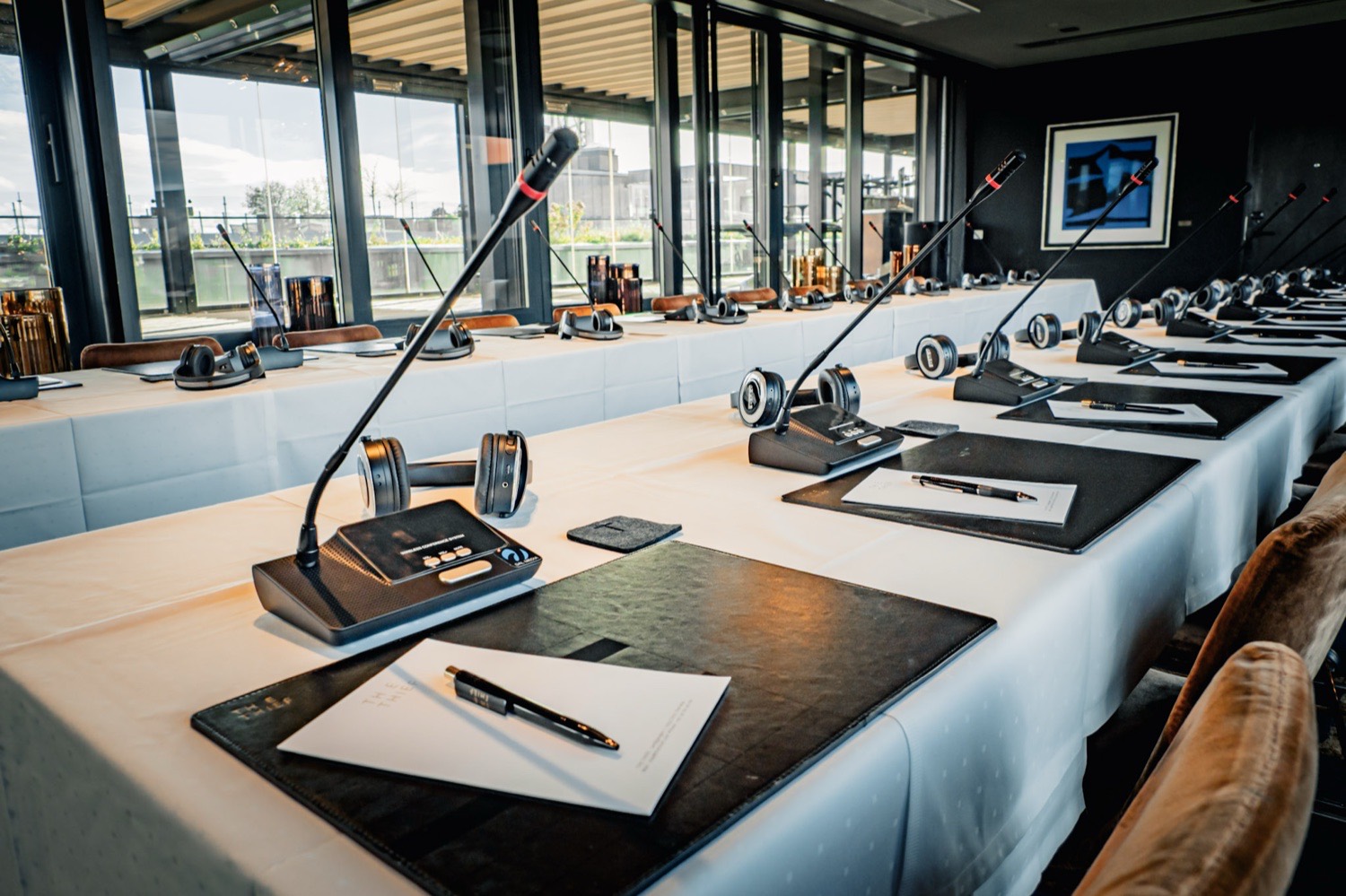
Interpretation is only as good as the audio going into it. In a discussion where people speak from the floor, delegate microphones are not a luxury — an interpreter cannot work from a voice picked up across a room. Where the format calls for it, we supply the conference microphone system as part of the same delivery.
Related
For the booths the interpreters work in, see interpreter booth rental. For events in the capital, see interpretation equipment in Oslo. Lead times, invoicing and VAT are covered in the FAQ and the note on Norwegian VAT.
Tell us the size of your audience
Date, venue, number of delegates and languages is enough for a complete quote. We reply in English within one business day.
Request a quote